The last of our new stainless steel tanks arrived from Italy today. After producing our first wine at one of the major cooperatives in the region from the 4,000 kg of Carinyena grapes that we harvested in September 2017, we had a rethink and decided to look for other alternatives. We were hoping to find somewhere more personal where we could control the wine production ourselves and start on a small scale without any major investment.
After much searching, we decided to rent space from Xavi Peñas (who also manages our operations) at “Cellers Sant Rafel”. So this means we have our own winery there and share some of the staff. We’ve now filled the space with 11 steel tanks with a capacity of about 30,000 litres and have also bought 20 or so oak barrels for storing our wines.
This lets us start on a smaller scale this year, producing about 20,000 bottles, and then gradually increase to about 75,000 bottles a year. The grapes that we are unable to use ourselves will be sold to local wineries.
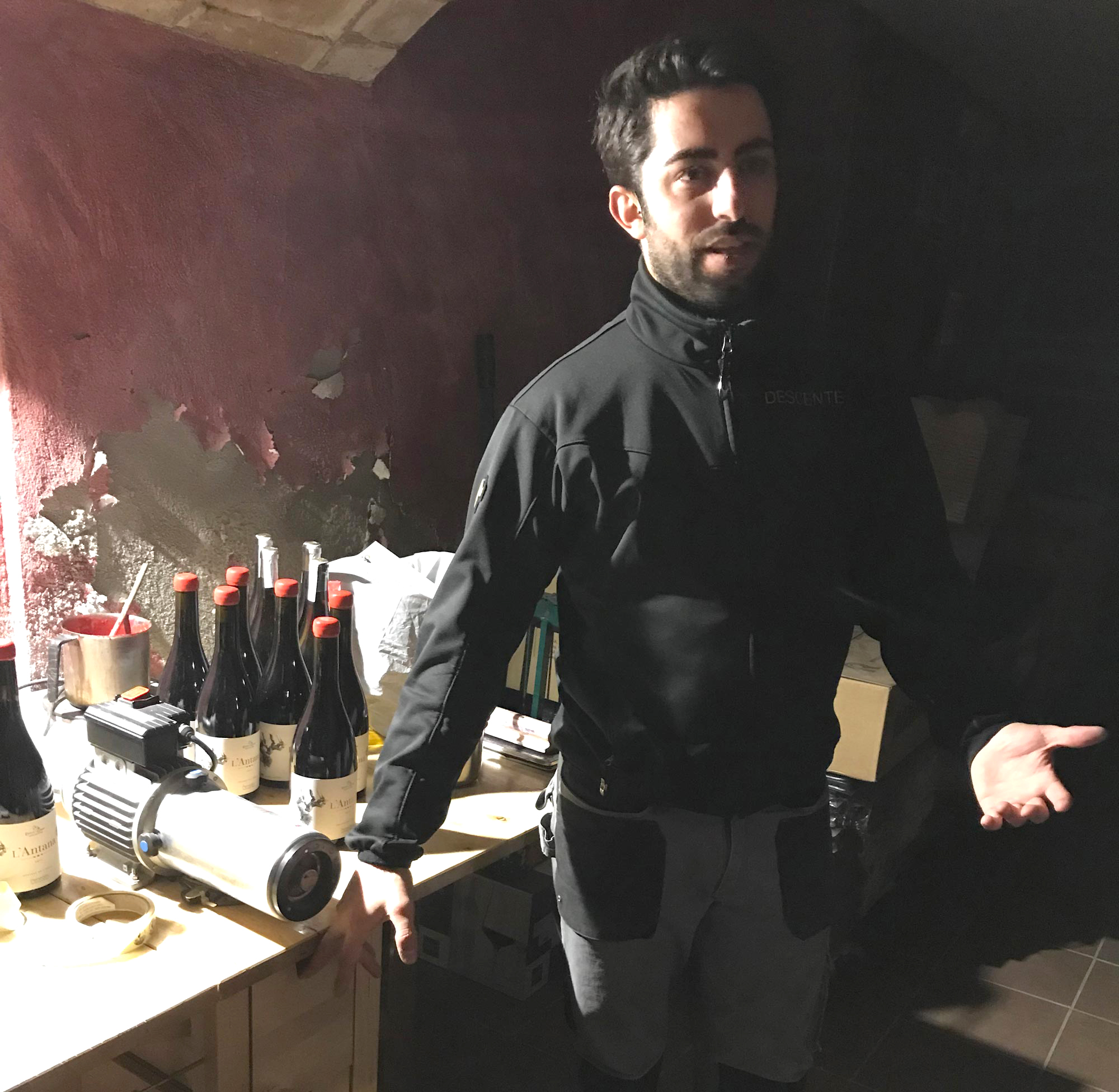
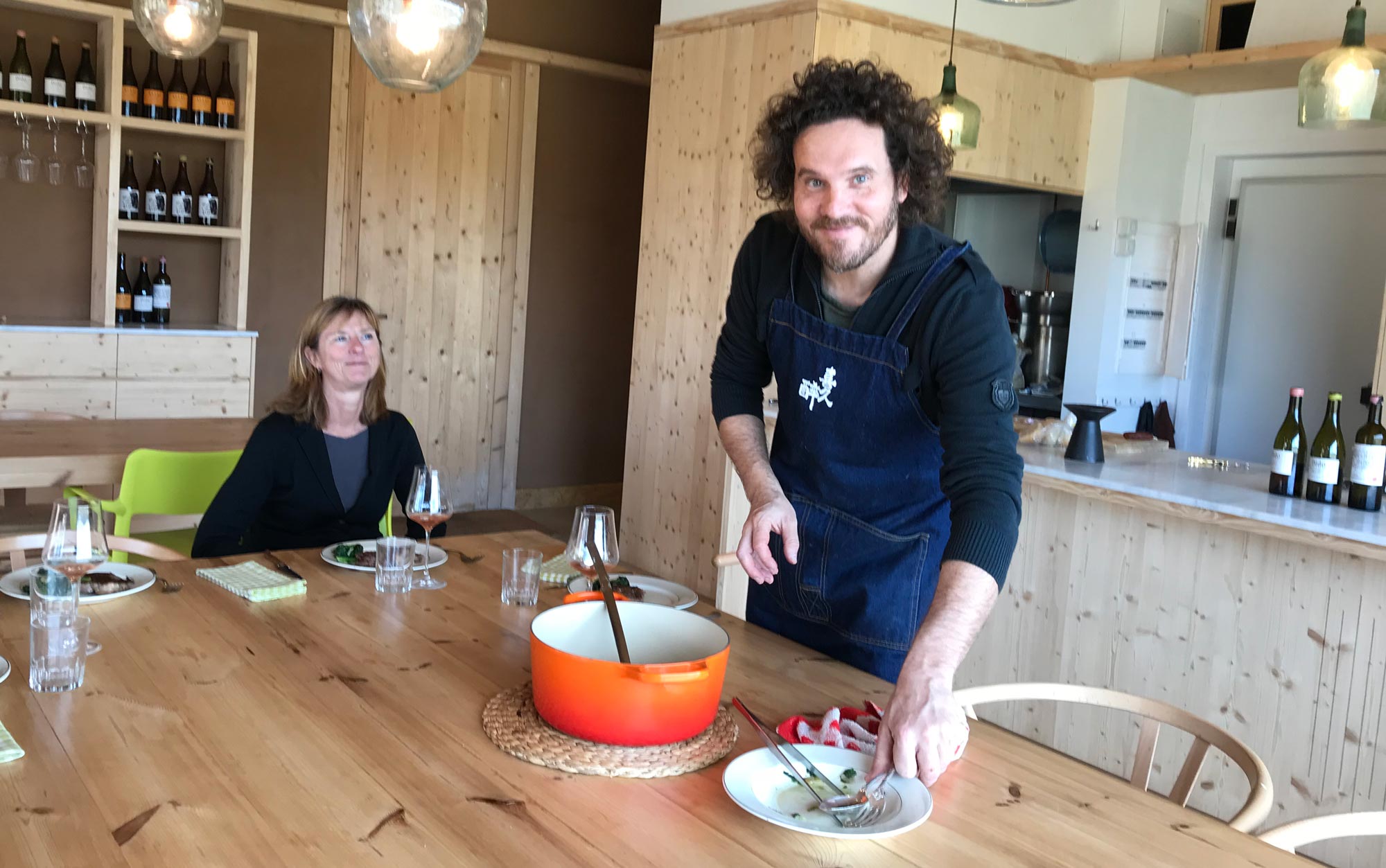
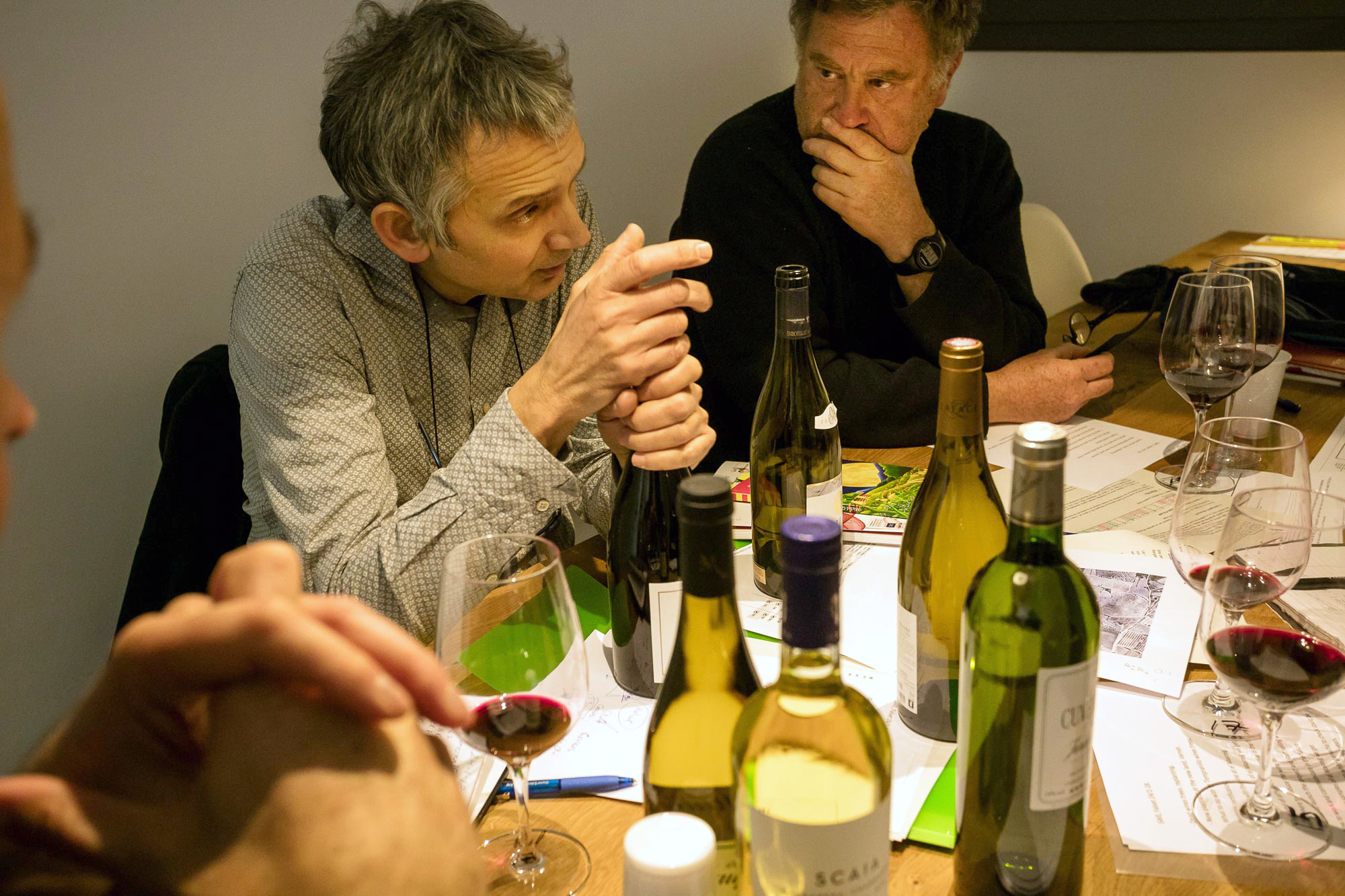
Oak barrels straight from France.Everything in place in our new premise.Xavi checks the technical details of the steel tanks.Happiness!!!
It has been extremely dry and hot for most of the spring and summer which has brought the harvest forward by a couple of weeks. At last, it was time for us to put theoretical learning into practice. We picked the Merlot grapes, which are adapted for growing in more northern, slightly cooler climates. That means they ripen earlier in our region than the local Cariñena and Garnatxa grapes.
The Merlot grape vines cover only a small patch of land. In all, we picked just over 600 kg, which makes about 500 bottles. The harvest didn’t take long at all. We started early as usual, but after a few hot and sweaty hours – at least for us northerners – in the sun, it was pleasant to move inside into the cool winery. There the grapes were destemmed, crushed and then pumped over into the steel tanks.
Now the must is left to macerate for a few days to allow the flavoring components and the coloring agents to leach from the grape skins. At this stage, the must is kept cool to prevent the onset of fermentation.
Hmmm, it was not as easy as it looks!Finished picking for today.Nico, Xavi and Joan separate the grapes from the stems and the grapes are crushed.This was a bit easier. The crushed grapes are pumped into the vat.A bit of yeast to help the fermentation.652 kg ready for fermentation.
Five extremely enjoyable and intense months have now come to an end. They began when we contacted Anna Serra Cases, www.grow-tdc.com, to ask for help in creating an identity and a brand. We gave Anna and her team three attributes that characterise (will characterise, the wine isn’t ready yet) the wine:
Elegant
Contemporary
Fresh
Moreover, the brand must be easy to remember, possible to pronounce in multiple languages (especially English, Catalan, Spanish and Swedish), have a local connection, be possible to register as a trademark, there has to be a dot.com address available, etc….
Anna presented us with a list of 100 different names. There is an incredible number of brand names registered for beverages. After much deliberation and double-checking existing registrations and other things, we chose “BELL CROS”. “BELL” means “beautiful” in Catalan. “CROS” is an old, local Catalan word for “valley”. “BELL CROS” can be translated as “BEAUTIFUL VALLEY”.
With that decided, it was then time to find a design/logo that graphically conveys the essence of the three attributes. The inspiration comes from a glorious day in autumn when the vines are starting to slumber after the harvest and their leaves gleam like bronze. The simple slash “/” is a stylisation of a row of vines seen as a line.
We are very pleased with the final result and hope that everyone will like it, because we’ll be living with it for a long time to come.
Lots of excellent suggestions to choose from!The final choice was “Bell Cros” with the logo “/”.
Next we had to decide what type of bottle to use. In practical terms, the bottle is the packaging for the wine. But it is also part of the feeling that communicates the brand.
In the D.O. Montsant, the appellation advocates using a Burgundy-type bottle. There are probably between 50 and 100 different versions of Burgundy bottles to choose from. Although they are all rather similar in appearance, they differ quite a lot when you hold them. A heavier bottle is generally considered to be more exclusive, but it is more expensive and has a bigger environmental impact than a lightweight bottle. A dark bottle protects the wine from exposure to UV light, but it is harder to see what type of wine is inside the bottle. The bottle is also regarded in different ways because of varying colours and shades, like brown oak-leaf tinted or green. And so on and so on… but we’ve now chosen a bottle for our wine!
Work on the name and logo is progressing in parallel but is not yet complete.
Spain is the largest producer of organic wine in the world, so the decision to turn organic feels quite natural. Our goal is to obtain organic EU certification under the supervision of the Catalan Council of Organic Production (CCPAE). It takes three years to convert a vineyard to organic, after which the EU logo for organic products can be used.
Many of the vineyards in Catalonia practise organic farming, but only a fraction of them have official certification as the process is considered expensive and complicated. The local wine farmers do not make wine themselves, they sell the grapes they grow to the local wine cooperative. The grapes are produced industrially to maximise the yield in kilograms per hectare. Wine cooperatives don’t usually have a payment system that rewards the quality and characteristics of the grapes, but pay the growers by the kilo. The land that we have bought has been farmed by winegrowers using chemical agents to optimise yields. The repeated use of chemicals over many years has depleted the soil.
Growing grapes organically is more expensive, but in return they produce a superior flavour. Organic farming requires more frequent inspection and care of the vines. The organic pesticides are not as effective as chemical controls and treatment has to commence early in the season. Organic treatments do not last as long and must therefore be applied to the vines more frequently.
We are working as hard as we can to restore the soil to its original state by adding micro-organisms and nutrients, such as nitrogen, that have leached from the soil over the years. It is going to take many years and will be a costly process, but it is worth the effort and is a debt that we owe to future generations.
We have now completed our basic training with Miquel after spending 17 intensive days together. Wine and politics have been recurring topics when driving from one vineyard to the next. Discussions have continued well into the night back at the hotel.
We’ve been given a solid grounding in how wine is produced and have studied the local red grapes Cariñena and Garnatxa which are used to make wine in Montsant and Priorat. We have sampled lots of fantastic white wines in Terra Alta and Penedés, made of Garnatxa, Parellada, Macabeu and Xarel-lo. As a kind of graduation celebration, we travelled around the Penedés region where 95% of all Cava is produced.
We met so many dedicated and wonderful people at the vineyards we visited. We were struck by how open and hospitable everyone is. There are no secrets here, rather the opposite. Everyone was happy to spend time talking to us and showing us around. A huge thank you to all the fantastic people who looked after us and have turned us into true wine enthusiasts!
Finally, we would like to thank Miguel for sharing his wealth of knowledge and experience with us and letting us into his enormous network of contacts that stretches across all wine-related areas. We must also say a special thank you for all the homework we have been given, which often involved tasting many different types of wine. School has taken on a whole new meaning for us and we’d love to do more homework.
Francesc Frisach, Celler Frisach opens a bottle of Ancestral sparkling wine.A demonstration of hi-tech wine production in elegant surroundings at the Herència Altés winery.Toni Carbó (left), La Salada & Mas Candi, lets us sample wine straight from the barrel. Wine produced using ancient methods.Cava producer Loxarel ferments and ages its wines in amphorae.Ann is offered a glass of “REFUGI” by Josep Mitjans, Loxarel, at the exit of “refugi” (bomb shelter) on the former military airfield.Albert Lopez, Esteve i Gibert Viticultors, is demonstrating how they label and seal the bottles with wax by hand.Eduards Pié (left), Sicus Celler, has his wine in amphoras buried in the ground.Eduards (right) hosts a party in beautiful and simple surroundings among the vines.Only natural wines are produced here and everything is done by hand. On the left, Antonella Gerosa, Partida de Creus.Our family couldn’t keep away when it was time to sample Cava. On the left, our daughter Ida and her boyfriend Nicholas.Mireia Borrell at Gramona gave us a fanatic tour around their vineyard.At the bottom is the cow’s horn in which Gramona lets its biodynamic preparations developing.Nicholas, Ida’s technically-minded boyfriend, is more interested in the production process at Vilarnau than in drinking Cava.René Barbier, Venus La Universal, not only makes fantastic wine but cooks delicious food too.Back to basics! Grapes are crushed in the traditional way here at Cellers Scala Dei.Josep Lluis Perez, Mas Martinet, one of the five winemakers who came from France and made Priorat famous in the 80s, shows Ann how different fermentation temperatures affect the wine.
At last we’ve acquired Garnatxa (Grenache) grape vines. Garnatxa and Cariñena are the two original grapes and are typical for D.O. Montsant. Today, we acquired another 6 hectares of land from a neighbouring couple Delfi Sabate Amoros and Jovita Pellise Pedrol. It comprises 2.5 hectares of Garnatxa, 0.5 hectares of Cariñena, just over 1 hectare of Ull de LLebre (Tempranillo) and 2 hectares of olive trees.
The total size of our vineyard is now about 20 hectares of connected land, made up of 12.5 hectares of vines which yield about 60 tons of grapes to produce some 50,000 bottles a year. Areas of land this size are unusual because the land in the district has been divided through inheritance into small farmsteads. All the grapes are red and the vines are between 50 and 70 years old. This guarantees top-quality, full-flavoured wines. Being able to combine the Garnatxa and Cariñena grapes also presents opportunities for an expanded and more varied line of products.
We have decided to expand the project now and are currently in negotiations for the purchase of more land. We have stopped working and the idea was and is to run this project part-time on a kind of “enjoyable commercial” basis.
But because of the size of the project, with the capacity to produce some 35,000 bottles of wine each year, we have decided to arrange matters in a way that enables both of us to manage the project professionally and enjoy it at the same time.
Xavi Peñas, who managed the process of buying our land, and our teacher Miguel Figini have become our good friends and advisors. With their help, we have now created Team-SWE (Skoglund Wine Estate S.L.). Xavi (who also manages a vineyard of his own “Cellers Sant Rafel”, www.cellerssantrafel.com) will be responsible for the administration of the business and serve as a link between everyone who is involved in it.
We are extremely proud that Joan Asens, an internationally recognised winemaker, has agreed to be our winemaker. Joan also runs his own vineyard “Orto Vins”, www.ortovins.com. Joan previously worked as chief oenologist at the famous Álvaro Palacio winery in D.O.Q. Priorat. He was largely responsible for the creation of L’Ermita, which sells for around EUR 1,000 per bottle.
Helping him is Baltasar Vendrell, who will be responsible for the practical work out in the field. The vineyard is where the creation of a wine starts, so Joan and Baltasar will be working closely as a team. Baltasar has years of experience of caring for vineyards and he grew up in a family that owns a vineyard, “Vendrell Rived”, www.vendrellrived.com.
We, Ann and Peter Skoglund, the owners of the vineyard will be responsible for the financial aspects and marketing activities of the business.
Let’s get going!!
There was a lot to discuss at our first meeting.
There was a lot to discuss at our first meeting.
There were as many different opinions on the choice of bottle as there were people at the meeting.There were as many different opinions on the choice of bottle as there were people at the meeting.Here we are discussing how the vines should be pruned to produce the type of wine we want, elegant and fresh.
We were recently contacted by another neighbouring couple, Eufrasio Rodriguez Carrillo and Maria Vernet Folch, who wondered if we might be interested in purchasing their land too, comprising 3.5 hectares of 100% Cariñena grapes. We were naturally interested and the transaction was finalised today.
We now own a total of 11.5 hectares, and the vines that are growing on 9.5 hectares of the land have the capacity to produce some 35,000 bottles of wine a year.
In November, almost a month after the first purchase, our neighbour Juan Salvador Vernet Peña asked us if we might be interested in purchasing his land, about 2 hectares of arable land, which we have now done. We intend to plant new vines here.